
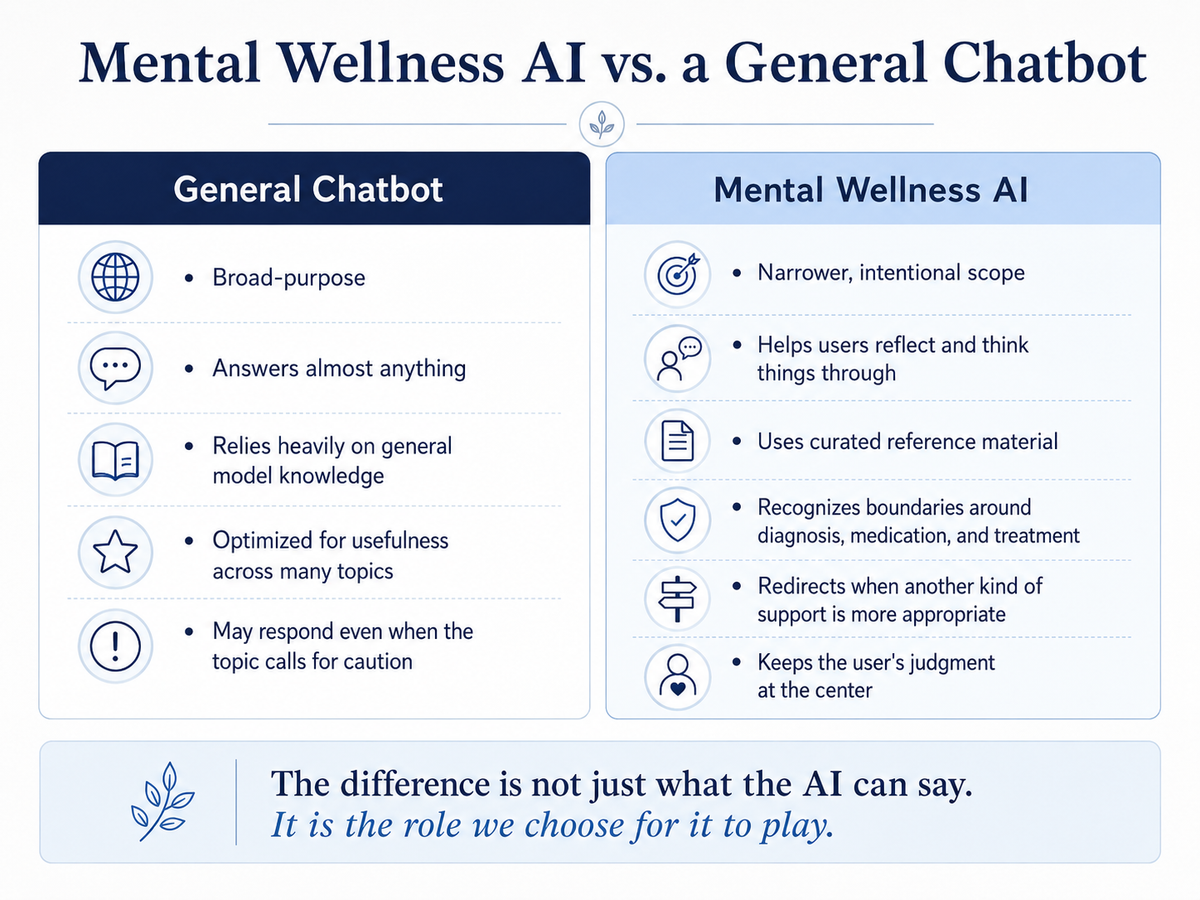
Artificial intelligence has become very good at conversation. A general-purpose AI can help write an email, explain a difficult concept, troubleshoot a technical problem, plan a trip, or answer a question about almost anything. That range is useful, but it also creates problems when the same technology is placed in a mental wellness setting.
A mental wellness AI should not just be a general chatbot with different branding. It needs a more focused role, clearer boundaries, and a better sense of when answering a question is actually helpful. That idea has shaped a lot of the decisions we have made while building My Mental Health Partner.
A More Focused Kind of Conversation
Most general-purpose AI systems are designed to handle whatever the user puts in front of them. MMHP is built for something narrower: helping people talk through the things that are weighing on them.
That might be stress at work, a difficult conversation, a relationship problem, frustration with a decision, or a thought they keep coming back to. In those moments, people are not always looking for information. Sometimes they are trying to make sense of what they are feeling or why they are reacting the way they are.
If someone asks, “What are common signs of stress?” there is nothing wrong with giving them a straightforward answer. But if someone says, “I made a mistake at work and now I feel like I am failing at everything,” a list of stress symptoms probably is not going to help much. A better conversation might explore what actually happened, why the mistake feels so significant, whether one bad outcome really says something larger about them, or how they would view the same mistake if a friend had made it.
The goal is not to tell someone what they should think. It is to help them work through the situation in a way that still leaves the judgment with them.
There Are Places AI Should Not Lead
One of the challenges with conversational AI is that it can sound confident even when it should not be. A polished answer can feel authoritative simply because it is written well.
That becomes more important when the conversation involves mental wellbeing. MMHP is not designed to diagnose someone based on what they say in a session. It is not there to tell someone to start, stop, or change medication, and it should not make treatment decisions that belong with a healthcare professional.
There are also situations where the system should stop trying to answer in the usual way and point the person toward the right kind of support. In some cases, recognizing when not to answer is part of being useful.
The same principle applies to everyday decisions. AI can help someone look at options, recognize patterns, or think through consequences, but it should not become the thing making the decision for them. A mental wellness tool should support a person’s judgment, not slowly replace it.
What the System Draws From Matters
The model itself is only one part of the system.
General-purpose AI relies heavily on what it learned during training. For MMHP, we wanted more control over the material that could influence a conversation, especially when the topic becomes more specific.
We use retrieval-augmented generation, or RAG, to bring relevant reference material into the conversation when it is needed. That material can include practical wellness education, cognitive techniques, coping strategies, and broader reference sources.
Building that system taught us pretty quickly that more information does not necessarily produce better answers. A large clinical reference might contain thousands of pages, while a much shorter resource can be more useful for the question someone is actually asking. If the system always favors the largest or most technical source, the response can become less relevant instead of more informed.
So the work is not just about giving the AI access to good information. It is also about deciding what kind of information should matter most in a particular conversation.
Useful Does Not Mean Unlimited
There is a tendency to judge AI by how much it can do. In a mental wellness setting, that is probably the wrong standard.
A good conversation does not always need a perfect answer. Sometimes a thoughtful question is more useful. Sometimes the system should acknowledge uncertainty. Sometimes it should recognize that the user is moving into an area where another kind of support makes more sense.
Those choices may make the system look less capable on paper, but they make it more responsible in practice.
Where MMHP Fits
The idea behind MMHP is fairly simple. There is a lot of space between having something on your mind and needing formal mental health care.
People replay conversations, worry about decisions, get frustrated with work, struggle with motivation, or need somewhere to put their thoughts into words before they can make sense of them. Most of those moments do not begin with someone looking for a diagnosis or treatment plan. They begin with a person trying to understand what is going on in their own head.
AI can be useful in that space, but it does not need to pretend to be something it is not.
We are not trying to build a system that imitates a therapist or answers every question someone could possibly ask. The goal is to build something that can hold a useful face-to-face conversation, recognize its own boundaries, and help people think through what is in front of them without taking that process away from them.
For me, that is what separates a mental wellness AI from a general chatbot. It is less about how much the system can say and more about the role we want it to play.